

|
QUICK ANSWER Olive oil can crystallise in the cold. For pure oil, solidifying on its own doesn't indicate spoilage or certify quality: let it gradually regain its fluidity, without using direct heat. |
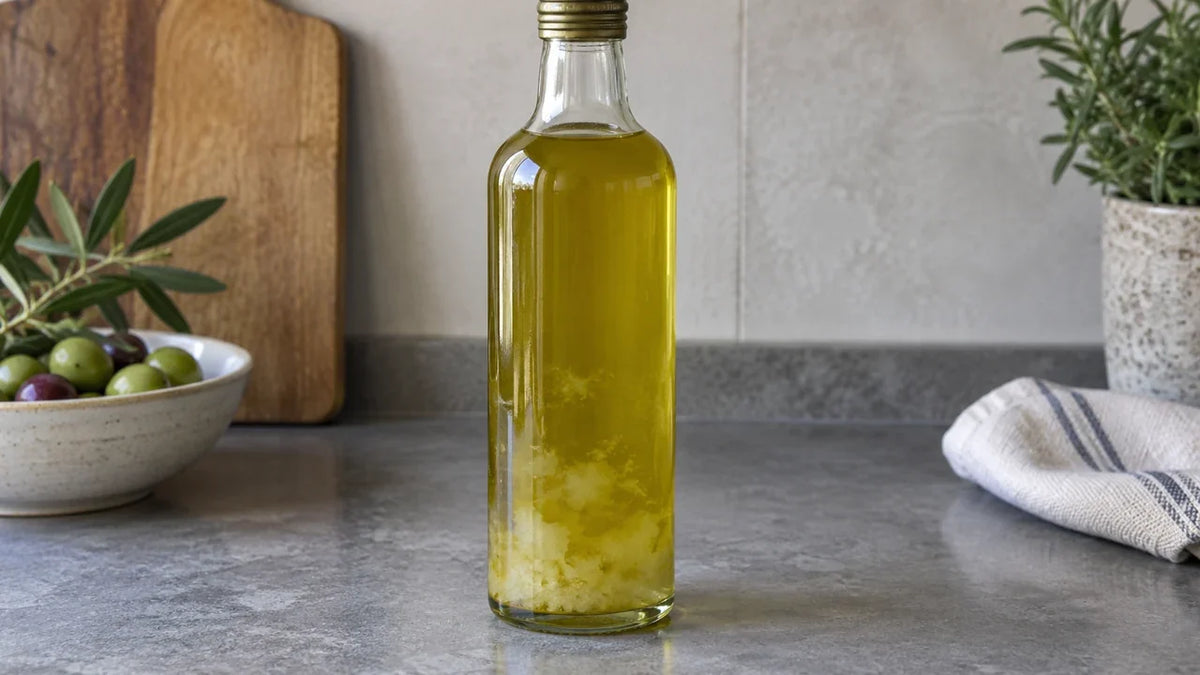
You open the pantry, pick up the bottle, and something's off: the oil looks opaque, there are pale flakes at the bottom, and barely a drop comes out of the spout. If the bottle has been somewhere cold, the explanation can be very simple. Olive oil can crystallise and turn partly solid, without that automatically meaning it's gone bad.
Before heating it, filtering it or throwing it away, it's worth working out where it's been stored. A night in the car, an unheated garage or a winter delivery can all change its appearance. The cold, though, can't even tell you whether it's genuine extra virgin: the famous fridge test isn't a quality check.
This guide is about pure olive oil. For jars of vegetables, sauces and seasonings with fresh ingredients, different storage conditions apply — check the label or the validated recipe used.
Why oil solidifies in the cold
When we say "frozen oil," we're describing a physical change, not necessarily ice forming. Oil isn't water: it's a mixture of substances, mainly triglycerides, which don't all react to temperature in the same way. As it cools, some fractions can crystallise before others. That's why a bottle can hold a liquid part and small solid clumps at the same time.
The change often starts with a haze. Flakes or denser patches can then appear; only in certain conditions does the whole mass become hard to pour. The room doesn't need to drop below zero. Even temperatures above freezing can change an oil's consistency, depending on its composition and how long it's been in the cold.
Picture a bottle left for a few days next to an outside wall. The kitchen might feel warm enough while you're cooking dinner, but that shelf could get much colder overnight. What matters is the container's actual temperature, not just what you feel walking into the room. A small thermometer near your stock helps you understand the issue without having to experiment on the oil itself.
At what temperature does olive oil freeze?
There's no single number that applies to every bottle. Saying that all oil freezes at exactly one temperature gives an impression of precision the product simply doesn't allow. Composition varies and crystallisation takes time: two oils in the same fridge can look quite different even after several hours.
A UC Davis Olive Center test compared seven samples at 4.7 °C. The behaviour observed meant cooling couldn't be used as a reliable test of purity or quality. That's the useful point for home use: don't expect a clean-cut threshold, and don't read how fast an oil solidifies as a grade for the producer.
To manage a household stock, it's more useful to look for a cool, dark and fairly stable spot. Avoid both shelves near heat sources and places that get very cold. If the packaging gives specific instructions, follow them. There's no need to turn your pantry into a climate-controlled room: just find a sensible spot and check how it changes between summer and winter.
White flakes, cloudiness and sediment aren't the same thing
Oil that's turned opaque after a cold night shouldn't automatically be confused with oil that's had sediment for a while. Unfiltered products can still contain particles and residual moisture from processing; crystallisation, on the other hand, is tied to cooling. The two can even coexist, so a single photo isn't enough to make a diagnosis.
Look at the context: was the bottle clear before being exposed to the cold? Is the cap intact? Is it pure oil, or does it contain herbs, garlic or other ingredients? Does the pale matter shrink as the bottle gradually returns to room temperature? These are useful details to gather, especially if you need to contact whoever sold you the product.
Returning to a liquid state doesn't certify the safety of just any contents. If there are foreign bodies, leaks, known contamination or a damaged seal, don't settle the doubt by tasting it. Set the package aside and ask for it to be checked. Avoid filtering it straight away too: you'd remove some of the evidence without having worked out the cause of the change.

How to bring frozen oil back to a liquid state
The simplest home solution is to let the bottle settle back gradually in a room-temperature space. Stand it upright, closed, on a stable surface away from the sun. If the outside is damp, dry it before putting it away. There's no need to shake it hard or keep opening and closing the cap.
The time this takes depends on the quantity, the container and the starting temperature. A small bottle and a large tin won't become fluid again at the same rate. So avoid promises like "just ten minutes will do": check the result and give enough time to the centre of the container too, not just the layer near the walls.
Once the oil flows again, check the packaging is intact and look at its overall appearance. If it's a bottle you know well and that's been stored correctly, you can go back to using it as usual. If something unexplained by the cold remains, document it and ask the producer. This process won't rescue an oil that was already oxidised or contaminated before it got cold: it changes the consistency, not its history.

Mistakes to avoid when you're in a hurry
Resting the bottle on a radiator can seem like a shortcut, but it makes the temperature hard to control. The same goes for direct sun on a windowsill, a lit oven, or a pot of very hot water. None of these are necessary to make the oil usable again, and they can expose the container to swings in temperature you don't want.
Don't put a closed bottle in the microwave. Besides not being a useful solution, packaging, caps and spouts aren't designed for that use. Don't break up the mass with utensils pushed into the neck: you could damage the glass, dirty the inside, or leave small fragments behind. Adding hot water directly to the oil is also a bad idea, since it introduces a foreign ingredient.
If you need to cook right away, use another bottle you have on hand and let the cold one recover calmly. Going forward, keep in the kitchen only the amount you regularly use, and store the rest somewhere suitable. Organising your stock works better than inventing a quick-thaw system every time you make lunch.
Is frozen oil still good?
Crystallisation on its own isn't the same as spoilage. It's important to separate what you can see from what you can actually conclude: an unusual texture signals a change, but it doesn't tell you everything about how the oil was produced, transported and stored. In the same way, a perfectly clear oil isn't automatically fresh or free of defects.
For a bottle of pure oil you know, that's intact and with no suspicion of contamination, accidental cold isn't reason enough to throw the product away. Once it's flowed again, check whether its usual fragrance is back. If you notice a clearly abnormal smell, don't try to mask it with aromas or cooking: ask the seller for a comparison, stating the batch and how it was stored.
There's no sensible promise of extra shelf life that applies to every chilled oil. Time already passed since opening still counts, as does exposure to light and air. Cold doesn't renew the date on the label, and it doesn't turn an old bottle into a product that's just come out of the mill. Keep the original references even after any transfer to another container.
The fridge test doesn't prove an oil is genuine
The idea is tempting: put two samples in the cold, wait, and whichever thickens must be the best. The problem is that a physical response doesn't replace analysis of composition or sensory assessment. In the university test mentioned above, different oils showed responses that made this shortcut unreliable.
So don't use the fridge to accuse a producer, confirm fraud, or choose between two bottles. Quality has to be assessed through verifiable information and, when necessary, appropriate testing. Colour, apparent density and price, taken on their own, can't answer the question "is this really extra virgin?" either.
Before buying, read the sales name, the stated origin and the producer's instructions. After opening, watch how the product behaves in everyday use. If you want to compare different profiles, Olio Pace's selection of extra virgin olive oils lets you start from each product's own characteristics, without turning freezing into a selection criterion. The comparison makes sense on the plate and in the information on the packaging, not in a race to see which solidifies first.
Fridge, freezer or pantry: what to choose at home
For a bottle you open every day, a suitable pantry spot is often the most convenient solution. The fridge can make the oil hard to pour and force you to keep moving it back and forth. That doesn't mean every kind of cold storage is wrong: it means telling a controlled method apart from an impractical household habit.
The UC Davis scientific summary on storage doesn't treat cold as inherently harmful and references studies carried out under defined conditions. These findings don't, however, give you grounds to set a new household expiry date on your own. At home, containers, how often the bottle is opened, quantity and how it's used all vary.
If you've bought more oil than you can manage, ask the producer for guidance before setting up long-term storage. For future purchases, choose formats and quantities that match your actual consumption. A less bulky package can make your life easier than an entire freezer shelf. Storing well also depends on deciding how much to buy, not just on where you put the bottles.
A winter delivery can arrive cloudy
Opening a parcel to find oil that barely flows can be surprising, especially if you ordered it as a gift. Before assuming a defect, check the packaging: is anything broken, leaking, or is a cap out of place? If the packaging is intact and the oil travelled through low temperatures, let it gradually reach room temperature.
Take a photo before doing anything, and keep the label, batch and order documents. If you contact support, explain when you received the parcel, where it's been kept, and how its appearance changed over the following hours. A concrete description gets you a more useful answer than "the oil looks strange."
Don't transfer the contents into another bottle right away: you'd lose the immediate link to the original packaging. If the oil is meant as a gift, prepare it a little ahead of time and don't leave it in the car overnight. The goal isn't to hide a natural phenomenon, but to deliver a product that's intact, recognisable and ready to use.

Three practical situations and how to handle them
A bottle forgotten in the garage. You pick it up in the morning and see pale flakes. Bring it into a room-temperature space, leave it closed, and wait. In the meantime, check whether the garage is really the right spot for your winter stock: if the problem keeps happening, move the still-sealed packages somewhere more stable.
A clear oil cruet always left on the kitchen counter. It thickens at night and flows again during the day near the stove. The thing to fix isn't just the cold: that spot combines temperature swings, possible direct light and closeness to heat. Choose a better-protected cupboard and a suitable container that seals well, while keeping the oil's own references legible.
A jar of vegetables with a whitish coating. Don't automatically apply the instructions for pure oil. Check the producer's stated conditions and the jar's history. The fact that the fatty part turns liquid again doesn't prove the rest is safe. If in doubt, don't taste it to check: preserved foods call for a different assessment than the seasoning's texture alone.
How to stop the problem happening again
Choose a spot for your stock and keep it tidy. An open bottle shouldn't disappear behind new packages, only to turn up again months later. Keep what you're currently using at the front, close it after every use, and don't transfer everything into unlabelled containers. If you do transfer it, keep a note of the batch and date shown on the original packaging.
Also think about format from a practical point of view. If you have little room in a suitable pantry, buying a large quantity can force you to store it in the garage or on the balcony. Any initial saving has to be weighed against how well you'll actually be able to manage the product. A stock that suits your habits is better than a purchase that's hard to store.
The final rule is simple: don't judge an oil by whether it freezes or stays liquid. Read the cold in context, avoid aggressive fixes, and ask for clarification if something doesn't add up. That way you can handle a temporarily thickened bottle without waste, and without crediting it with qualities that phenomenon alone doesn't prove.
What to tell the producer if the doubt remains
When the change can't be explained by the cold, prepare a message with a few precise details: product name, batch number, opening date and storage location. Add a photo of the whole bottle and one of the detail that concerns you, taken without altering the contents. If you've transferred the oil, say so and describe the container used.
Avoid jumping to conclusions like "it's fake because it doesn't freeze." Ask instead whether the appearance is consistent with that product and what checks would be appropriate. Keep the packaging until you get a response: the batch lets the producer trace information that a simple image doesn't contain. If the issue concerns integrity or suspected contamination, stop using it in the meantime.
Frequently asked questions
Why does oil turn white in the cold?
Some components crystallise and change how the oil looks in the light. Haze or pale flakes can appear. If the cause is cold, the phenomenon can reverse as the oil gradually returns to room temperature.
Should frozen oil be thrown away?
Not for solidifying alone. For pure oil, intact packaging and known storage, let it regain its fluidity first. If you suspect contamination or damage to the container, don't consume it until the doubt is resolved.
At what temperature does olive oil freeze?
It doesn't have a single solidifying temperature. Composition and time spent in the cold affect the result; part of it can crystallise while the rest stays liquid.
How do I thaw a bottle of oil?
Leave it closed, upright and away from direct heat sources, in a room-temperature space. Wait for it to flow again without using an oven, microwave or boiling water.
If the oil doesn't freeze, does that mean it's fake?
No. The fridge test doesn't reliably determine purity or quality. For doubts about authenticity, you need appropriate checks, not a home solidification test.
How long does oil take to turn liquid again?
It depends on the quantity, the container material, and the starting and ambient temperatures. There's no guaranteed time for every bottle: let the contents settle back gradually.
Can I use the microwave to warm up frozen oil?
Don't put the bottle or tin in the microwave to thaw it. Caps and packaging may not be suited to it. For pure oil, it's enough to wait for it to flow again in a room-temperature space.
Does oil in the fridge always lose quality?
No: cold doesn't automatically mean it gets worse. For everyday use, though, thickening can be inconvenient. Follow the producer's instructions and don't assume extra shelf life just from having refrigerated it.
Is sediment at the bottom always frozen oil?
No. It can also come from particles in an unfiltered oil, or from other causes. Consider the bottle's history and ask the producer if the sediment stays unexplained.
Do the same rules apply to vegetables preserved in oil?
No. The oil's texture doesn't certify the safety of the preserve. Follow the jar's instructions and don't taste suspect products to decide whether they're still usable.


