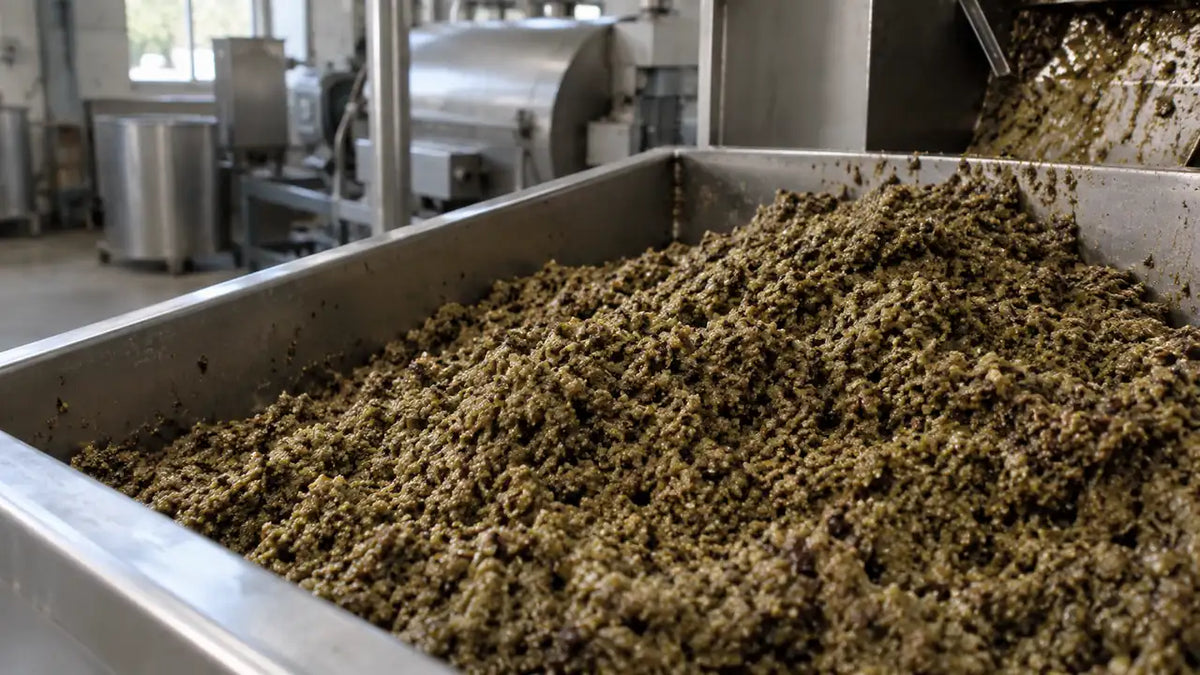
In brief: olive pomace is the solid matter left over after the oil has been extracted, made up mainly of skins, residual pulp and fragments of pit. It isn't a worthless leftover: it can go on to further processing, composting, biomass energy, or the production of olive-pomace oil.
The word pomace comes up often in conversations about olive oil, but it gets confused with olive-pomace oil, with pruning waste, or with a lower-quality product. Understanding the difference helps you read the categories correctly and avoid jumping to conclusions. Pomace is a secondary raw material from milling; olive-pomace oil is a product obtained by treating that material with specific processes and then blending it according to the rules set out for that category.
What olive pomace is
During crushing and separation, the olive is divided into an oily phase, a watery phase, and a solid part. That last part is the pomace. Its composition varies depending on the cultivar, ripeness, moisture, type of decanter, and how the mill is set up. Wetter pomace holds more vegetation water; drier pomace may be better suited to certain energy or industrial recovery uses because it's richer in residual oil.
Pomace isn't simply "the useless part" of the olive. It still contains organic matter and, in some cases, a residual share of oil. That's why it's handed over to specialised plants, used as a soil conditioner after suitable treatment, or sent for other recovery processes. The correct destination depends on regulations, authorisations and the material's characteristics, not on an on-the-spot decision at the mill.
How it forms during milling
Pomace is produced once the olive paste has been processed and separated. In a two-phase system it's generally wetter, because the vegetation water stays together with the solid part; in a three-phase system the pomace can come out drier, but more water is produced that then needs managing. The type of plant changes the residue's consistency and destination, but it doesn't turn pomace into edible oil.
It has to be managed quickly. Piling up pomace the wrong way can lead to fermentation, odours and seepage. A well-run mill collects it in dedicated areas and sends it on to authorised operators. Traceability matters here too: recording quantities, movements and destinations shows that the by-product is handled responsibly.

Pomace and olive-pomace oil: not the same thing
Pomace is the solid residue from milling. Olive-pomace oil, on the other hand, is obtained from pomace through processes that recover the residual oily fraction, normally through extraction followed by refining. After refining, the product is blended with virgin olive oil according to the category it falls under. It should therefore never be confused with extra virgin, which comes directly from the olives and is obtained using mechanical processes only.
The difference is spelled out in the sales name. If a bottle or tin reads "olive-pomace oil," it belongs to a different category from extra virgin olive oil. It isn't right to use the word pomace as a synonym for harmful, but it's just as wrong to present the two categories as equivalent. They differ in origin, process and sensory profile, and the right one to choose depends on the stated use and your expectations.
How pomace is put to good use
One possible destination is extracting the residual oily fraction. Other paths include energy production, biomass recovery, composting, or industrial uses after the required treatments. The choice depends on moisture, distance from the processing centre, transport costs and local regulations. Putting pomace to good use means cutting down on waste without overlooking safety requirements.
The sector is looking for ways to recover water, polyphenols and biomass components, but every application has to be assessed case by case. A marketing story might talk about a circular economy, but the real proof lies in authorisations, processes and traceability. For the consumer, it's enough to know that the modern supply chain can use many of the olive's components; but not everything left over after extraction can be put straight back to use in the kitchen.

Why pomace matters to the olive mill
Managing pomace affects a mill's costs, space and organisation. During the harvest, volumes rise quickly, and an unplanned build-up slows the work down. The miller has to coordinate delivery, collection, movement and removal. Good logistics protect both the environment and the continuity of production.
The residue can still hold water and organic matter, so it needs protecting from spills and unauthorised contact. A serious mill tells growers who deliver olives how it's managed and keeps the required records. Transparency matters for the less visible steps of the supply chain too: the consumer can ask for information and judge whether the company looks at the whole process, not just the bottle.
Pomace, pit fragments and pruning waste: the differences
Pomace comes from processing the olive. The pit fragments are the woody part of the seed, which can be separated from the pomace and used for energy or industrial purposes. Pruning waste, by contrast, comes from the tree's branches and leaves and has different characteristics. Keeping these materials separate avoids mistakes, both in how they're managed and in how they're talked about.
When a company talks about olive biomass, ask which fraction it uses and with what treatment. A product obtained from pit fragments isn't the same as one obtained from wet pomace. This precision also matters when you're assessing pellets, fuels or soil conditioners. The words "natural" and "organic" aren't enough on their own to describe a secondary material: you need the process, the certification and the intended use.

Pomace and the quality of the oil
Pomace on its own doesn't determine the quality of the oil extracted from the olives. The result depends mainly on the raw material, timing, hygiene, temperature, oxygen exposure and storage. Even so, poorly managed residue can be a sign of a disorganised mill. The main measure of quality is the oil itself, but the way the pomace is handled says something about how seriously the supply chain is run.
It isn't right to think that more pomace automatically means a higher yield or lower quality. The quantity depends on the cultivar, moisture and technology used. In the same way, a modern process doesn't eliminate the residue: it manages it better. If you're choosing a producer, look at the whole picture, including how willing they are to explain what happens after separation.
How to read labels when the word pomace appears
If you're buying oil, look for the full sales name. "Olive-pomace oil" identifies a specific category; "pomace" in a description of the process can instead refer to the by-product, not to what's in the bottle. Don't stop at words like "mill-fresh" or "traditional": check the legal line, the origin, and the operator responsible.
When the product is extra virgin, the label has to say so clearly. You can compare it with Olio Pace's selection of extra virgin olive oils, checking format and sensory profile. If you're after a declared agricultural supply chain, the certifications page helps you tell verifiable data apart from generic claims.
Pomace and sustainability: what's fair to say
Putting pomace to good use can help make fuller use of the olive and cut down on some waste, but it isn't a shortcut to calling a product automatically sustainable. It takes efficient transport, proper treatment, energy and impact controls. Sustainability is judged across the whole supply chain, not on a single by-product.
A transparent producer avoids absolute promises and explains which fractions it recovers, with which partners and for what purpose. The consumer can reward that clarity by choosing companies that make the process easy to understand. Packaging, format and delivery distance are also part of the overall picture. Pomace is one piece of it, not the whole environmental story.
A practical guide: finding your way between pomace and oil
If you're reading an article or a product page, first work out what the sentence is actually about. If it's talking about the milling residue, "pomace" means the solid matter; if it's talking about a bottle, "olive-pomace oil" means a commercial category. Keeping these two meanings apart clears up most of the confusion.
When you're comparing two oils, don't use price or the word "mill" as your only guide. Read the category, the origin and the container. An extra virgin and an olive-pomace oil can serve different purposes, but they aren't interchangeable if you're after the aromatic profile and the naming that come with extra virgin. If you're in doubt, ask the seller for a full photo of the label.
If you visit a mill, notice where the pomace is collected and how it's taken away. You don't need to go into the working areas: it's enough to ask who collects it and whether its destination is tracked. That kind of curiosity gives you a fuller picture of the work and helps you tell an organised plant apart from one that lets residue pile up unchecked.
Lastly, avoid two extremes: treating pomace as useless waste, or turning it into proof of a circular economy. It's a by-product with potential, but every use requires a process. What you choose to buy still comes down to the oil's category, its sensory quality and how clearly the supply chain is explained.
What happens to the pomace after collection
Once collected, the pomace is transported to a plant that knows its moisture content and composition. The path can include drying, separating out the pit fragments, recovering the oily fraction, or converting it into biomass. Each step takes energy and checks, so it isn't right to describe the recovery process as free or automatic. Putting it to good use works when the logistics and treatment match the material actually available.
For the mill, having a reliable partner means less stock sitting around and fewer unnecessary movements. For the local area, it means avoiding build-ups that attract insects, produce odours or generate run-off. The authorisations set out which uses are allowed and how transport and storage have to be managed. A producer that mentions these aspects shows it's also thinking about the stage after the oil, rather than using sustainability as mere decoration.
How to talk about it correctly
When you explain the supply chain to a customer, always specify whether you're talking about pomace as a by-product or about olive-pomace oil as a food. Avoid phrases like "pomace is good for you" or "pomace is toxic": these are oversimplifications that don't describe either the material or the process accurately. Use concrete verbs instead: it's separated, collected, treated, recovered, or sent on.
The same goes for environmental promises. Saying that a share of the pomace is put to good use is different from declaring that the whole production has zero impact. If the producer provides data, report it along with its context; if it doesn't, keep the story to what's verifiable. Precise communication also makes the more emotional part of the mill's story more credible.
To understand the value of pomace, picture the whole cycle: the olives arrive at the mill, the oil is separated out, the solid part is collected, and the material is sent to an authorised plant. Every link in that chain takes time and costs money. Putting it to good use is industrial work, not an improvised home reuse. That distinction protects consumers from overly simple do-it-yourself advice.
When talking with a producer, you can ask what share of the pomace is collected and where it generally ends up, without expecting confidential details about their partners. A clear answer is enough to know the residue isn't simply abandoned. If the company claims a circular-economy project, consider whether it also explains the energy, transport and limits involved. Credibility grows when the story includes what isn't perfect.
Pomace is also a reminder that oil doesn't come only from the liquid in the bottle. There's water, pulp, pit and packaging materials to manage as well. A responsible mill takes these flows into account and cuts down on waste wherever the rules allow. Consumers can reward that approach by choosing companies that document their work without crediting a single by-product with absolute virtues.
When choosing a producer, also look at how honestly they talk about the limits: wet pomace may need more energy to treat, a small batch may not be worth transporting economically, and some destinations depend on the season. Real sustainability admits to conditions and trade-offs. That honesty is more useful than an absolute promise, and it makes the supply chain easier to understand even for people outside the industry.
In this sense, pomace is a good example of how the quality of a food also depends on what happens outside the bottle. Knowing the journey it takes helps you choose more transparent producers and use precise words when talking about sustainability.
In short
Olive pomace is the solid residue from milling, while olive-pomace oil is a category obtained by treating the residual oily fraction. Telling the two apart helps you read labels, understand the mill's work, and judge sustainability and quality more realistically.
Learn more on Olio Pace
- Discover our extra virgin olive oils
- Read about our supply chain's certifications
Frequently asked questions
What is olive pomace?
It's the solid part left over after the oil has been extracted, made up of skins, residual pulp and fragments of pit.
Is pomace waste?
It's a by-product that can be put to good use through extraction, biomass energy, composting or other authorised purposes.
Are pomace and olive-pomace oil the same thing?
No. Pomace is the solid residue; olive-pomace oil is a product obtained by recovering and refining the residual oily fraction.
Is olive-pomace oil extra virgin olive oil?
No. It's a different category, clearly stated in the sales name.
How does pomace form?
It forms when the olive paste is separated into an oily, a watery and a solid phase.
What's the difference between pomace and pit fragments?
Pomace contains skins, pulp and parts of the pit; pit fragments are the woody fraction separated from the seed.
Does pomace affect the quality of the oil?
Not directly, but how it's managed can show how organised and careful the mill is about the supply chain.
Can pomace become compost?
Yes, after proper treatment and handling, in line with regulations and the material's characteristics.
Why does pomace need to be removed quickly?
To avoid build-ups, fermentation, odours and management problems during the harvest.
How should I read the word pomace on a label?
Check whether it refers to the milling residue or to the sales name "olive-pomace oil," which identifies a specific commercial category.


